Walking your dog should be something you can both enjoy, but constant pulling can make even a short walk feel stressful and exhausting.
If your dog pulls, you are certainly not alone. The Dogs Trust National Dog Survey 2025 found that pulling on the lead was the most commonly reported behaviour challenge, affecting 44% of dog owners.
The good news is that dogs can learn to walk on a loose lead without being corrected, frightened or subjected to uncomfortable equipment. It takes patience, consistency and an understanding of why your dog is pulling in the first place.
Why do dogs pull on the lead?
Dogs rarely pull because they are trying to be dominant or take control of the walk.
They usually pull because:
- They naturally walk faster than humans.
- The environment is exciting or overwhelming.
- They want to reach a smell, person, dog or interesting place.
- Pulling has previously helped them get where they wanted to go.
- They have not yet learnt what we would like them to do instead.
- They are worried and trying to move towards safety—or away from something uncomfortable.
- They are frustrated by being restrained.
- Their physical or emotional needs have not been fully met.
Before concentrating on training, consider what might be motivating your individual dog. A dog rushing towards every lamppost may need more opportunities to sniff, while a dog pulling frantically away from traffic may be frightened rather than simply untrained.
Start with suitable equipment
Comfortable, well-fitting equipment helps your dog move naturally and makes learning easier.
We generally recommend:
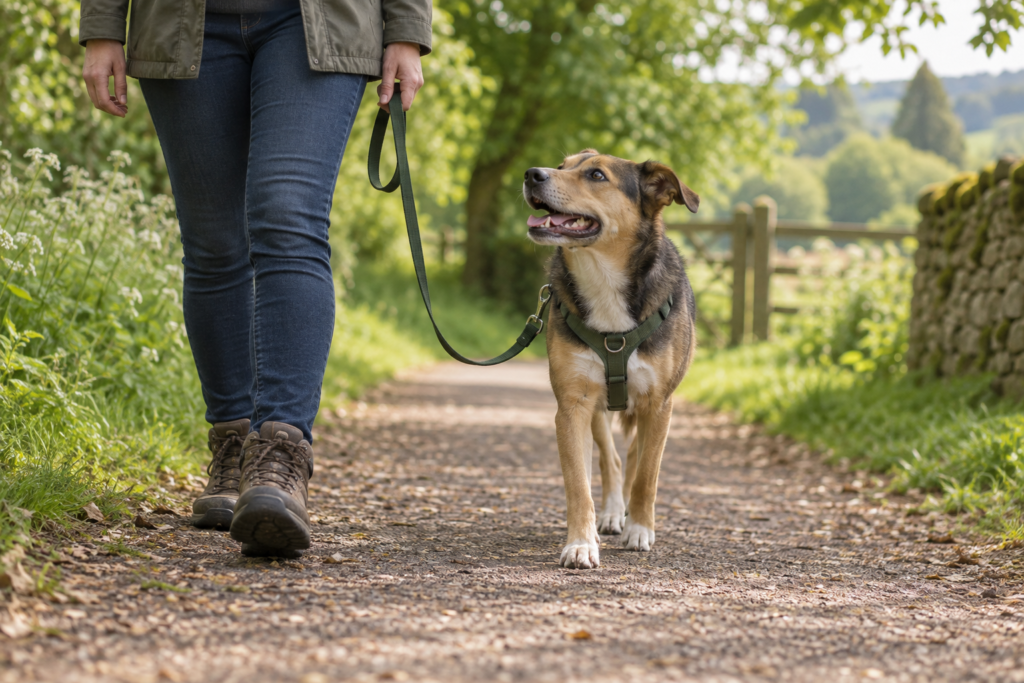
- A comfortable, well-fitted Y-shaped harness that does not restrict shoulder movement.
- A fixed-length lead that gives your dog enough room to move and sniff.
- Rewards that your individual dog genuinely values.
- A treat pouch, toy or another reward that is easy to access while walking.
Equipment can help keep everyone safe, but it cannot teach loose-lead walking by itself.
Avoid equipment designed to stop pulling through pain, pressure, fear or discomfort. This includes choke chains, prong collars, electric collars and slip leads used as a method of controlling or correcting pulling.
These tools do not address why a dog is pulling. Tightening equipment around the neck can also cause discomfort and may negatively affect the dog’s welfare or their feelings about walks.
Begin somewhere easy
A busy park full of dogs, people and exciting smells is a difficult classroom.
Start somewhere calm, such as your home, garden, driveway or a very quiet stretch of pavement. Your dog should be able to notice you, respond and think clearly.
If they cannot, the environment may currently be too distracting or overwhelming. Creating more distance or choosing a quieter location can make a huge difference.
Reward the position you want
Begin by rewarding your dog whenever they are close to you and the lead is loose.
Rewards do not always need to be food. Depending on what your dog enjoys, you could use:
- A small food reward
- Part of your dog’s normal daily food allowance
- Verbal praise
- A favourite toy or brief game
- Permission to move forwards
- Access to an interesting smell
- The opportunity to explore
- Gentle affection, if your dog genuinely enjoys being touched
Some dogs are very motivated by food, while others find sniffing, movement or play far more rewarding. Observe your dog and use what is meaningful to them.
You do not need to insist on a formal heel position. For an everyday walk, your dog can move, look around and sniff—as long as the lead remains comfortably loose.
Try the following:
- Stand with your dog beside you.
- Reward them for being near you while the lead is loose.
- Take one or two steps.
- If they remain with you, calmly mark the moment with “yes” or another consistent word.
- Give or provide the chosen reward.
- Gradually increase the number of steps between rewards.
If you use food, the pieces can be very small. You can also use some of your dog’s usual daily food rather than continually adding extra treats.
At first, reward frequently. You are building a new skill, not testing whether your dog already understands it.
What should you do when the lead becomes tight?
If your dog reaches the end of the lead, avoid jerking them backwards or telling them off.
Instead, calmly pause or change direction. The moment the lead becomes loose and your dog reconnects with you, continue walking and reward them.
The important lesson is:
A loose lead allows the walk to continue. Pulling does not make things happen more quickly.
However, repeatedly stopping may not help if your dog is frightened, highly frustrated or too overwhelmed to learn. In that situation, increase the distance from the trigger or move to a calmer area.
If stopping causes your dog to become more frustrated, try gently changing direction before the lead becomes fully tight. Reward them when they turn and move with you.
Use everyday rewards
Food can be useful, but it is only one of many possible rewards.
For many dogs, being allowed to reach an interesting smell is incredibly valuable. Ask for a few steps on a loose lead and then release your dog to sniff with a phrase such as “go sniff”.
Other dogs may be rewarded by moving forwards, exploring a new path, playing briefly with a toy or receiving calm praise from their person.
This teaches your dog that walking with you does not mean losing access to the things they enjoy. Instead, keeping the lead loose helps them reach those things.
Try to think of a reward as something your dog values, rather than something we assume they should enjoy. Sniffing, exploring and making appropriate choices are important natural behaviours that can make walks more enriching and satisfying.
Keep training sessions short
Loose-lead walking requires concentration. Five successful minutes can be far more productive than an hour of struggling.
You could practise for a few minutes at the beginning of the walk and then move to a safe area where your dog can explore on a longer lead.
Progress gradually:
- Start indoors or in the garden.
- Move to a quiet outdoor area.
- Introduce mild distractions at a comfortable distance.
- Gradually practise in more challenging locations.
Dogs do not automatically understand that a skill learnt in the garden also applies outside the school gates or beside an exciting field. Practising in different environments helps them generalise the behaviour.
Meet your dog’s needs
Training is much harder when a dog is overexcited, worried, uncomfortable or desperate to explore.
Consider whether your dog is receiving suitable opportunities for:
- Sniffing and exploration
- Rest and sleep
- Play
- Enrichment
- Breed-appropriate activities
- Safe off-lead exercise or freedom on a long line
- Calm, enjoyable time with you
A walk does not need to cover a huge distance to be valuable. A shorter, relaxed walk with time to sniff may be more beneficial than a long, stressful march.
Avoid these common mistakes
Expecting too much too quickly
Loose-lead walking is a complex skill. Reward small improvements and build gradually.
Only rewarding occasionally
New behaviours need regular reinforcement. If the environment is highly rewarding but walking beside you rarely is, pulling is likely to win.
Remember that reinforcement does not always mean giving treats. Moving forwards, sniffing, exploring, playing or gaining access to another enjoyable activity can all reinforce behaviour.
Correcting the dog for pulling
Lead jerks, shouting and physical corrections may interrupt the behaviour momentarily, but they do not teach your dog what you would like them to do.
Corrections can also increase worry, frustration or discomfort, particularly if the dog is already struggling emotionally.
Training in an environment that is too difficult
If your dog cannot respond, engage with you or disengage from a distraction, they may be too overwhelmed to learn effectively.
Move further away, find a quieter location or make the exercise easier.
Removing all opportunities to sniff
Walks are for your dog too. Allowing appropriate freedom and exploration can reduce frustration and make walking together more enjoyable.
Expecting a piece of equipment to solve the problem
A harness may make walking more comfortable and help with safe management, but equipment alone cannot teach your dog how you would like them to walk.
Could pain be contributing?
A sudden change in walking behaviour should not be ignored.
If your dog has recently started pulling, rushing, stopping, lagging behind or reacting when their harness is fitted, discomfort or pain could be involved.
Changes in posture, movement, tolerance of handling or enthusiasm for walks should also be taken seriously. Speak to your veterinary practice before assuming the problem is purely behavioural.
When should you seek professional help?
Consider asking for professional support if:
- Pulling is making walks unsafe.
- Your dog is lunging, barking or reacting to dogs, people or traffic.
- Your dog appears frightened or overwhelmed outside.
- The behaviour has changed suddenly.
- Your dog is physically difficult for you to manage.
- You have tried training consistently but are not making progress.
- You are unsure which equipment or approach is suitable.
A knowledgeable, reward-based professional can observe your dog, identify what is driving the pulling and create a plan suited to both of you.
Find kind, ethical support
Every dog is an individual. Loose-lead walking is not about forcing a dog to remain beside you—it is about helping them feel safe, understand what is expected and learn that staying connected with you is rewarding.
If you would like personalised help, you can find an ethical dog trainer or behaviourist through The Ethical Dog Trainers Network.
Our independent members use kind, ethical approaches that put your dog’s welfare first.
